Planescape review: Mysteries of the Stones
For the last three years, I've run a Planescape1 campaign through almost all of its modules. Now, after successfully finishing it, I want to look back and review these adventures, highlighting the pros and cons of each one.
Each module will be rated in three categories, up to 3 points in each:
- Presentation: how easy it is to understand and run the adventure.
- Openness: how open the adventure's scope is, regarding the freedom of choice.
- Quality: Overall quality of the adventure, including the originality and richness of its content, and players' enjoyment.
The full list of currently published reviews is available under the planescape tag.
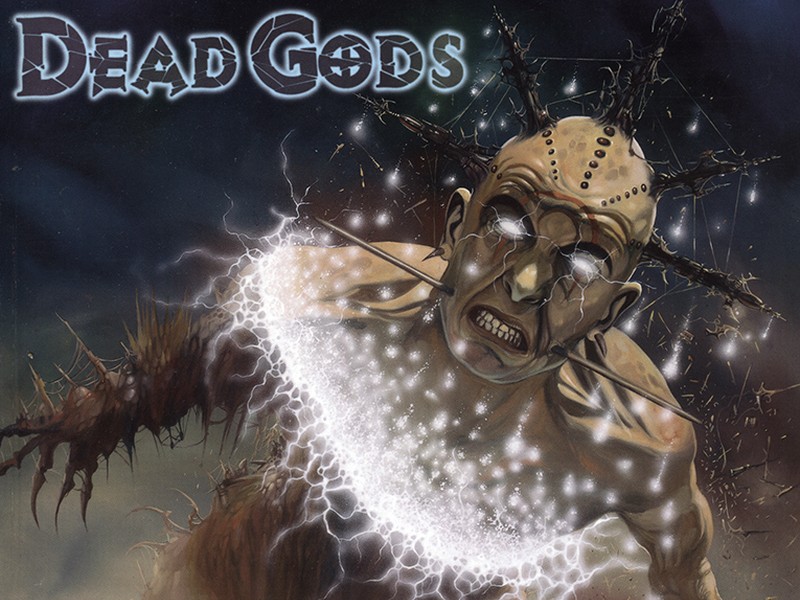
Mysteries of the Stones
In which the Heroes confront the secret Villain of the story, journey through the fading Remembrances of a god, and restore a fragile Peace to Sigil - the only kind it can ever truly know.
- Designer: Monte Cook
- Source: Dead Gods:2 Into the Light, Part Three
- Party: 4-6 characters of 6th-9th levels
- Play-time: 1 session
- Locations:
- Sigil
The third and final part of the Into the Light book picks up when some time has already passed since the last time, when the hidden mastermind behind the whole commotion around the ruined church, Argesh Fiord, decides to make his move against the party, geasing the characters by the name of Badir, the forgotten dead god, to go to the church and speak the name there. This is the same reason behind all prior disappearances: all who hear the dead god's name must venture there, disappearing between the mysterious stones carved from the god's corpse and containing fragments of Badir's memories.
The First Stone: The Temple
The characters assume the roles of Badir's worshipers in one of his ancient temples and have a chance to save one of the disappeared Lower Ward workmen from the blades of belligerent Badirines when the dead god speaks inside their minds the words of mercy and love, which the characters can repeat to the fanatics.
The Second Stone: The Palace
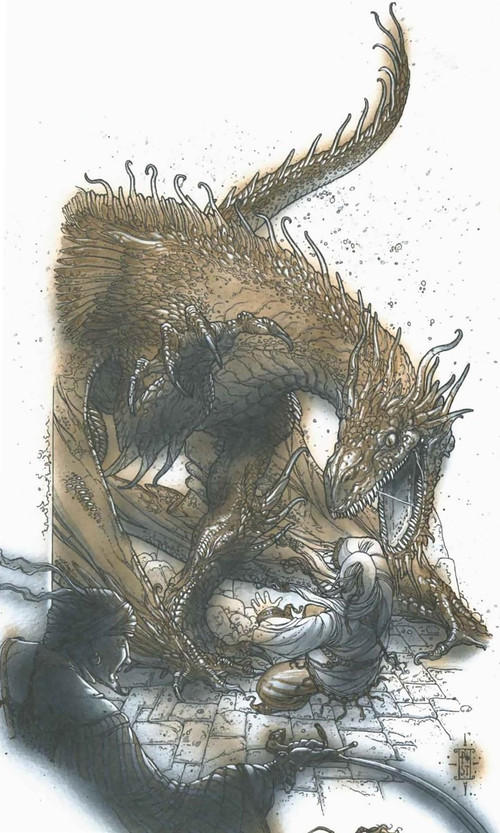
Here, the characters are the palace guards in the palace of Badir's father, the sun god Nol — a memory from Badir's childhood. When a bronze dragon attacks young Badir, the party must save him lest they forfeit their chance to complete the rest of the module. The palace guard gear is quite formidable (+3 weapons and armor), and spellcasters even have some additional spells for the time being. Unlike the rest of the dream sequences, even if any of the characters die while defending the godling, they reappear in the old church alive, retaining only half of the sustained damage. Naturally, the characters themselves have no way of knowing this fact during the battle.
The Third Stone: The Battlefield
Once again, the characters find themselves clad in the armor of Badir's followers on the battlefield against the hordes of Nol. After charging against the enemy, the party once again hears the dead god's words in their head and must fend off a band of Nolite berserkers attempting to kill off the wounded soldiers.
The Fourth Stone: Another Palace
The characters assume ghostly forms in a crumbling palace, observing the moment of Badir's death. In one of the rooms, they find a crying woman, a handmaiden to one of Badir's proxies, from whom they hear a story of the Badir religion's downfall at the Nolite blades. The characters can persuade her to console the dying god in his last moments, and after Badir's death, they reappear in the old church again.
The Fifth Stone: The Astral Plane
The fifth memory is of the last Badirites cutting out stone blocks from their patron's corpse on the Astral Plane and carving them into forms the party already knows — the standing stones of the ruined church.
The Sixth Stone
When the characters reappear in the old church, the sixth, previously unseen stone emerges between the other five and plunges the party into the last memory. This one, however, represents the events that are about to happen. Here, the characters must defeat Argesh Fiord and his green slaad mercenary before opening a portal that will return Badir's remains back to the Astral Plane, uniting the ring of god's existence.
With the dead god's wish fulfilled, the ruined church vanishes from the streets of Sigil without a trace, effectively ending the feud between the Athar and Signers. The war between the factions is avoided… for now.
Presentation
🖋️🖋️🖋️ superb
Each dreamscape is represented by a small color map on the poster sheet, including scale and grid where needed, and all NPCs and monster stats are given in the appendix.
Openness
☀️ linear
No saving throw or magic resistance can prevent them from completing that action — the compulsion is backed by the power of a god (albeit a dead one).
Enough said, even the order of the stones is predetermined. While inside the dead god's memories, the characters still have their free will, they still must complete whatever is needed for the adventure to be considered successful — a design choice I wouldn't recommend anyone adhering to.
Quality
★★ good
Despite its painful linearity, the dream sequences themselves are quite immersive and evocative, mirroring those of the Ruins of Pelion, albeit that one did slightly better in the openness department. While this trilogy has almost nothing to do with the main story of Out of the Darkness except the general theme of the "dead gods", it is nevertheless memorable in its own right. I wouldn't recommend running it by the book: giving the party more freedom and room for choice would be a much preferable alternative.

Discuss this post on Reddit